Character Origins
How Chinese characters evolved from ancient pictographs to the forms you write today — the real stories behind the strokes.
The Unhinged Ones
Characters whose etymologies read like horror movie plots

Accidentally Poetic
Characters that turned out more beautiful than they needed to be
A Brief History of Chinese Characters
Chinese characters are among the oldest continuously used writing systems in the world. The earliest known examples — oracle bone inscriptions (甲骨文) — date back over 3,000 years to the Shang dynasty, when diviners carved questions into turtle shells and ox bones before heating them to read the cracks. Many of these early characters were pictographs: simple drawings of the sun, moon, mountains, and animals that are still recognizable in their modern forms.
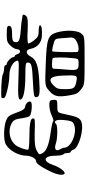
As Chinese civilization expanded, so did its script. Bronze inscriptions (金文) from the Zhou dynasty show characters becoming more standardized and abstract. The pivotal moment came in 221 BC, when Qin Shi Huang unified China and imposed a single writing system — small seal script (小篆) — across the empire. This standardization made written communication possible across vast distances and diverse dialects, a role Chinese characters continue to serve today. The subsequent evolution through clerical script (隶书) and into regular script (楷书) gradually simplified strokes while preserving the structural logic of each character.
What makes Chinese characters remarkable is how many preserve traces of their original pictographic logic. The character for “mountain” (山) still looks like three peaks. The character for “door” (门) still suggests a double-leafed gate. But most characters have also accumulated layers of meaning through millennia of use — phonetic components were borrowed, semantic radicals were added, and scribal errors were occasionally adopted as standard. Understanding these layers of history transforms character learning from rote memorization into a window onto 3,000 years of culture, thought, and daily life.
Want to go deeper? Read our guide to 25 characters with wild etymologies — from marriage as a kidnapping at dusk to love losing its heart during simplification.