
The final 2025 HSK 3.0 syllabus lists 11,000 numbered vocabulary entries across seven vocabulary bands and nine proficiency levels. We analyzed HSKStory's cleaned version of that material: 10,896 distinct searchable items after deduplication and written-form normalization.
Looking for the official syllabus? Word counts are one part of it. See the HSK 3.0 Syllabus Guide for topics, tasks, and grammar by level.
Word Counts by Level
| Level | Official Cumulative Entries | Official Entries Added | Cleaned Distinct Items | Cleaned Items Introduced |
|---|---|---|---|---|
| HSK 1 | 300 | 300 | 300 | 300 |
| HSK 2 | 500 | 200 | 496 | 197 |
| HSK 3 | 1,000 | 500 | 988 | 493 |
| HSK 4 | 2,000 | 1,000 | 1,978 | 990 |
| HSK 5 | 3,600 | 1,600 | 3,557 | 1,579 |
| HSK 6 | 5,400 | 1,800 | 5,334 | 1,777 |
| HSK 7-9 | 11,000 | 5,600 | 10,896 | 5,562 |
The official syllabus publishes one shared HSK 7-9 advanced vocabulary band rather than separate vocabulary lists for levels 7, 8, and 9.
The cleaned HSK 2 and HSK 3 files are not perfect supersets of the preceding files because some written forms are normalized at later levels. For that reason, "cleaned items introduced" is a set comparison between adjacent files, not simple subtraction, and the introduced figures should not be summed into a second cumulative total.
How HSK 3.0 Compares to HSK 2.0
| Level | Old HSK Words | Official HSK 3.0 Entries | Change |
|---|---|---|---|
| HSK 1 | 150 | 300 | +100% |
| HSK 2 | 300 | 500 | +67% |
| HSK 3 | 600 | 1,000 | +67% |
| HSK 4 | 1,200 | 2,000 | +67% |
| HSK 5 | 2,500 | 3,600 | +44% |
| HSK 6 | 5,000 | 5,400 | +8% |
| HSK 7-9 | N/A | 11,000 | New |
The lower-level headline counts grew most sharply: HSK 1 doubled, while HSK 2 through 4 each grew by about two-thirds. HSK 6's headline count changed less, but totals alone do not show which words moved, entered, or left the list.
The largest structural change is the new shared HSK 7-9 advanced band, which takes the official cumulative total from 5,400 to 11,000 entries.
The HSK 7-9 Advanced-Band Jump
The move from HSK 6 into the shared advanced band is the largest vocabulary increase in the framework:
- 5,600 official entries, or 5,562 cleaned items
- About 51% of the cumulative advanced-band list
- About 3.1 times the official increase from HSK 5 to HSK 6
The list size therefore nearly doubles between HSK 6 and the combined HSK 7-9 band. This measures vocabulary-list growth, not how many of those words an individual learner knows.
Character Length in the Cleaned List
| Length | Words | Percentage |
|---|---|---|
| 1 character | 1,503 | 13.8% |
| 2 characters | 8,546 | 78.4% |
| 3 characters | 389 | 3.6% |
| 4 characters | 458 | 4.2% |
Nearly four out of five cleaned entries contain two characters. The balance shifts across the introduced-item sets:
| Level (introduced cleaned items) | Single Character | Two Characters |
|---|---|---|
| HSK 1 | 45.7% | 48.0% |
| HSK 3 | 25.6% | 68.8% |
| HSK 5 | 15.5% | 81.2% |
| HSK 7-9 | 8.7% | 80.0% |
At HSK 1, single-character entries make up nearly half the list. By HSK 5, two-character entries account for more than four-fifths of the introduced set. Character length describes written form; it does not by itself determine whether an entry is a compound or how easily a learner can understand it.
The Four-Character Expression Surge
Four-character form does not automatically mean chengyu. The cleaned data includes true chengyu alongside other fixed expressions, compounds, and modern terminology.
| Levels | Four-Character Expressions |
|---|---|
| HSK 1-4 | 4 |
| HSK 5 | 7 |
| HSK 6 | 17 |
| HSK 7-9 | 430 |
The HSK 7-9 cleaned additions contain 430 four-character expressions, more than 15 times the 28 found in all preceding introduced-item sets combined. Genuine chengyu in this group include 亡羊补牢 (mend the pen after the sheep are lost), 画蛇添足 (draw legs on a snake), and 守株待兔 (wait by the stump for another rabbit). The same group also includes modern terms such as 市场经济 (market economy), 社会主义 (socialism), and 资本主义 (capitalism).
See the complete list of four-character expressions by HSK level, which distinguishes the broader four-character category from chengyu.
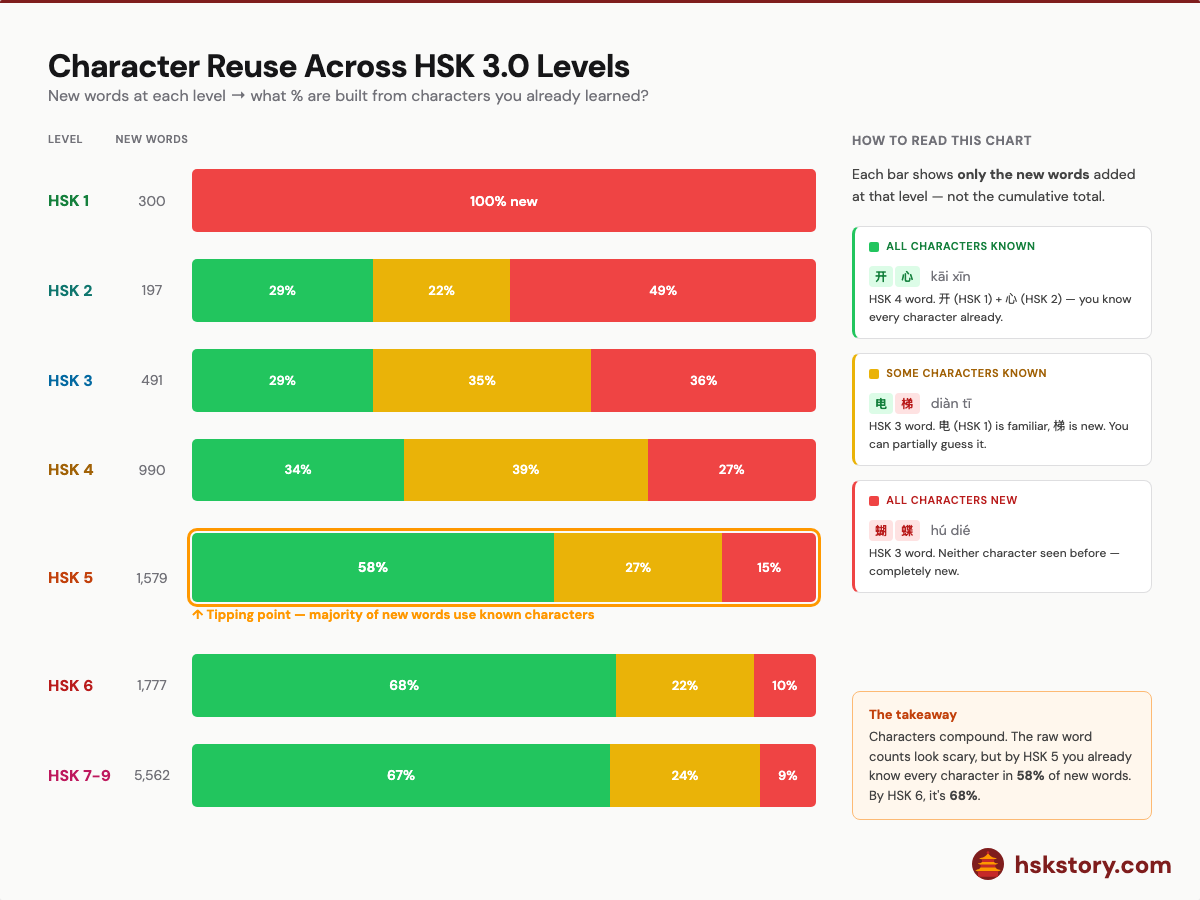
Character Reuse Increases at HSK 5
We decomposed each introduced cleaned item into its written characters and checked whether those characters appear anywhere in the preceding cleaned vocabulary file.
| Level | Introduced Items | Fully Reused | Partially Reused | No Reused Characters | % Fully Reused |
|---|---|---|---|---|---|
| HSK 1 | 300 | 0 | 0 | 300 | 0.0% |
| HSK 2 | 197 | 57 | 44 | 96 | 28.9% |
| HSK 3 | 493 | 143 | 171 | 179 | 29.0% |
| HSK 4 | 990 | 333 | 389 | 268 | 33.6% |
| HSK 5 | 1,579 | 922 | 424 | 233 | 58.4% |
| HSK 6 | 1,777 | 1,206 | 387 | 184 | 67.9% |
| HSK 7-9 | 5,562 | 3,741 | 1,325 | 496 | 67.3% |
Fully reused means every written character appears somewhere in the preceding cleaned file. Partially reused means some do. No reused characters means none do. This is a property of the lists, not a claim about whether a learner recognizes a character, knows its pronunciation and meanings, or can infer the new word.
HSK 5 is the first introduced-item set where more than half of entries use only characters present in the preceding cleaned file: 58.4%, up from 33.6% at HSK 4. The fully reused share reaches 67.9% at HSK 6 and 67.3% in the shared HSK 7-9 additions.
Use the HSK 7 vocabulary list as HSKStory's searchable entry point into that shared advanced-band jump. Each cleaned item includes pinyin and an English definition.
Across the full cleaned list, the 10,896 items contain 3,088 distinct written characters. Each distinct character appears in an average of about 6.95 cleaned items, although the distribution is highly uneven.
The Most Productive Characters
Some characters occur in far more entries than others. The top 10 by occurrence appear in 982 distinct cleaned items, or 9.0% of the list. Seven of those ten characters already occur somewhere in the cleaned HSK 1 vocabulary.
See the full analysis with expandable word families for each character in our dedicated productive characters guide.
48 characters appear in introduced items at every vocabulary band, from HSK 1 through the shared HSK 7-9 band. Examples include 不, 一, 上, 下, 来, 好, 学, 时, and 开. This recurrence helps explain why character components remain useful throughout the lists.
What This Means for Your Study Plan
The list structure suggests three practical phases. These are study suggestions, not conclusions tested by the vocabulary data.
HSK 1-3: Build the Foundation (988 cleaned items)
Nearly half the cleaned HSK 1 list consists of single-character entries. At these levels, explicit vocabulary review can help establish characters, pronunciations, meanings, and common combinations.
Graded stories at your level provide repeated contextual exposure alongside that review, showing the same characters in different words and sentences.
HSK 4-6: Notice Character Reuse (4,346 introduced cleaned items)
From HSK 5 onward, more than half of introduced cleaned items use only characters found in the preceding file. That makes character families and recurring components useful ways to organize study, but reused characters do not guarantee that a new word is transparent.
Our HSK 4, HSK 5, and HSK 6 story collections provide contextual reading that can complement saved-word review and flashcards.
HSK 7-9: Manage the Shared Advanced Band (5,562 introduced cleaned items)
The cleaned vocabulary nearly doubles, and the introduced set includes 430 four-character expressions alongside professional, formal, literary, and technical vocabulary.
Extensive reading, explicit vocabulary study, and spaced review can play complementary roles at this scale. Use the methods that fit your target skills and the kinds of material you want to understand.
Official entry counts and band structure come from the final 2025 HSK 3.0 syllabus (新版HSK考试大纲). Word-length, four-character-expression, character-reuse, and productivity calculations use HSKStory's 10,896-item cleaned dataset after deduplication and written-form normalization. Analyze your own Chinese text against HSK levels with our HSK Analyzer.