
China has published a 9-level HSK framework, and a global HSK 3.0 pilot ran on 31 January 2026. CTI's official launch announcement confirms that HSK 3.0 exams open worldwide on 13 December 2026. If you have been studying with the older levels in mind, the useful questions are what changed, which syllabus your exam uses, and where your current vocabulary overlaps the new framework.
This guide is a side-by-side comparison with specific numbers, level contrasts, and practical advice.
Quick answer: HSK 3.0 expands the framework from 6 levels to 9. The old standard reaches 5,000 official cumulative words, while the new official syllabus reaches 11,000 cumulative numbered entries; HSKStory's normalized new index contains 10,896 distinct written forms. The worldwide official HSK 3.0 exam launch is scheduled for 13 December 2026. HSK 7–9 is one combined HSK 7–9 exam that returns a level result.
Structure: 6 levels to 9 levels
Want to see the exact words? Use our HSK 3.0 Word Diff Tool to compare old and new vocabulary lists word by word.
The most visible change is the expansion from 6 levels to 9. The official syllabus's cumulative numbered entries are 300, 500, 1,000, 2,000, 3,600, 5,400, and 11,000. HSKStory's normalized distinct written-form counts are 300, 496, 988, 1,978, 3,557, 5,334, and 10,896; these are repository normalization outputs, not official published totals.
The table uses those normalized distinct-form counts for the new system. Its CEFR column is HSKStory's estimate for learner orientation; CTI does not publish this CEFR mapping.
| Old HSK (2.0) | Official cumulative words | New HSK (3.0) | HSKStory normalized distinct forms | CEFR estimate |
|---|---|---|---|---|
| HSK 1 | 150 | HSK 1 | 300 | A1 |
| HSK 2 | 300 | HSK 2 | 496 | A2 |
| HSK 3 | 600 | HSK 3 | 988 | B1 |
| HSK 4 | 1,200 | HSK 4 | 1,978 | B2 |
| HSK 5 | 2,500 | HSK 5 | 3,557 | C1 |
| HSK 6 | 5,000 | HSK 6 | 5,334 | C2 |
| (none) | — | HSK 7 | 10,896 | C2+ |
| (none) | — | HSK 8 | 10,896 | C2+ |
| (none) | — | HSK 9 | 10,896 | C2+ |
The official framework adds three advanced result bands. The normalized counts in the table are useful for comparing repository word lists, but they should not be read as CTI's published totals.
The Official HSK 2.0 Vocabulary Counts
For reference, the official cumulative word counts under the old HSK 2.0 standard were 150, 300, 600, 1,200, 2,500, and 5,000 for levels 1 through 6 respectively. Each level's figure is cumulative — old HSK 4's 1,200 words included everything from levels 1-3, not 1,200 new words on top.
| Old HSK level | Official cumulative words |
|---|---|
| HSK 1 | 150 |
| HSK 2 | 300 |
| HSK 3 | 600 |
| HSK 4 | 1,200 |
| HSK 5 | 2,500 |
| HSK 6 | 5,000 |
Those six numbers are the ones most study plans, textbooks, and level charts published before 2021 were built around, which is why they still circulate widely. Every one of them is superseded under HSK 3.0 — the new equivalents are 300, 496, 988, 1,978, 3,557, and 5,334, with levels 7-9 sharing a 10,896-word pool.
How old vocabulary coverage compares
There is no official conversion from an HSK 2.0 result to an HSK 3.0 level. Comparing cumulative totals alone cannot produce one: the lists differ, and an exam result measures more than whether you recognize a given number of words.
Use your old result as evidence of prior study, then compare your listening, reading, writing, speaking, and vocabulary with the requirements for the exam you plan to take. A diagnostic can identify gaps, but it cannot convert an old certificate into a new result.
The free 2-minute HSK level quiz tests directly against the HSK 3.0 word lists if you want an initial estimate of where to start.
Vocabulary changes in detail
The final HSK 3.0 syllabus has larger cumulative lists and differs from HSK 2.0: entries were added, removed, or assigned to different levels. Here is how the normalized comparison looks at each level:
What changed beyond word counts
Vocabulary is only one part of the revision. HSK 3.0 also redefined the topics, tasks, and grammar expected at every level, from survival Chinese at HSK 1 to academic research at HSK 7-9. The HSK 3.0 syllabus guide covers that framework.
Beginner levels (HSK 1-2)
Old HSK 1 was extremely minimal: 150 words covering greetings, numbers, family, and basic objects. New HSK 1 doubles this to 300 words, adding more everyday vocabulary like 面包 (bread), 饺子 (dumplings), 飞机 (airplane), and 高兴 (happy).
Old HSK 2 had 300 official cumulative words. HSKStory's normalized new HSK 2 index has 496 distinct written forms and expands into daily routines, simple opinions, and basic descriptions. Words like 高铁 (high-speed rail), 高考 (college entrance exam), and 鲜花 (fresh flowers) appear at this level.
To see these words in action, try HSK 1 stories like 生日饭店 (Birthday Dinner) or HSK 2 stories like 第一次做饭 (Cooking for Two).
Intermediate levels (HSK 3-4)
This is where the normalized comparison changes sharply. Old HSK 3 had 600 official cumulative words; HSKStory's normalized new HSK 3 index has 988 distinct written forms. The new list includes more vocabulary for work, travel, and social situations.
Old HSK 4 had 1,200 official cumulative words; HSKStory's normalized new HSK 4 index has 1,978 distinct written forms. If you passed old HSK 4 and are aiming for new HSK 4, compare the actual lists rather than treating the count difference as a conversion. New HSK 4 covers terms like 市场 (market), 师傅 (master/skilled worker), and more abstract expressions.
Read graded stories while working on these gaps: HSK 3 stories and HSK 4 stories are grouped by editorial difficulty rather than presented as strict single-list vocabulary samples. Editors develop, closely edit, and approve every story.
Upper levels (HSK 5-6)
Old HSK 5 had 2,500 official cumulative words; HSKStory's normalized new HSK 5 index has 3,557 distinct written forms. The new index includes professional and academic vocabulary such as 录取 (admit/enroll), 形势 (situation), 影响 (influence), and 彻底 (thorough).
Old HSK 6 had 5,000 official cumulative words; HSKStory's normalized new HSK 6 index has 5,334 distinct written forms. The totals are close, but the actual lists differ: entries changed levels, were removed, or were added across areas including science, technology, and formal writing.
Practice at these levels: HSK 5 stories and HSK 6 stories.
Advanced levels (HSK 7-8-9)
These advanced bands have no HSK 2.0 counterparts. The official syllabus has one cumulative 11,000-entry endpoint for HSK 7–9; HSKStory's normalized index contains 10,896 distinct written forms. The list includes literary, technical, academic, and formal vocabulary.
CTI administers one combined HSK 7–9 exam, not separate HSK 7, HSK 8, and HSK 9 exams. It reports one of four outcomes: below HSK 7, HSK 7, HSK 8, or HSK 9. The official exam page describes a shared test covering listening, reading, writing, translation, and speaking.
The HSK 7-8-9 advanced-level guide explains the combined exam and its reported levels.
Modern vocabulary in the HSK 3.0 syllabus
The final HSK 3.0 syllabus includes vocabulary for contemporary transport, online activity, shopping, and technology. The examples below show where these terms occur in HSKStory's normalized index; inclusion here does not mean that every term was absent from HSK 2.0.
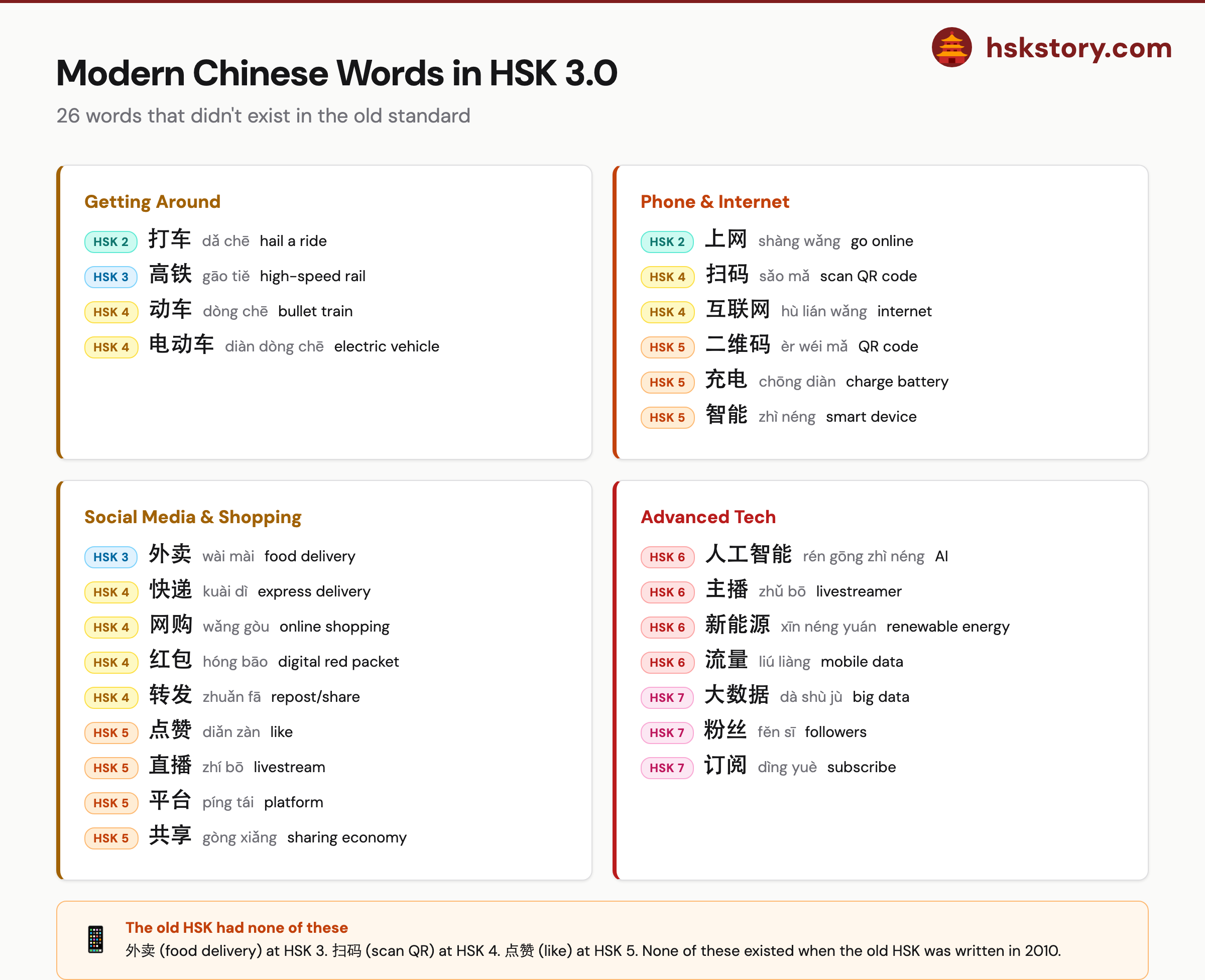
Getting around
| Word | Pinyin | Meaning | HSK Level |
|---|---|---|---|
| 打车 | dǎ chē | hail a ride | HSK 2 |
| 高铁 | gāo tiě | high-speed rail | HSK 3 |
| 动车 | dòng chē | bullet train | HSK 4 |
| 电动车 | diàn dòng chē | electric vehicle | HSK 4 |
Phone and internet
| Word | Pinyin | Meaning | HSK Level |
|---|---|---|---|
| 上网 | shàng wǎng | go online | HSK 2 |
| 扫码 | sǎo mǎ | scan QR code | HSK 4 |
| 互联网 | hù lián wǎng | internet | HSK 4 |
| 二维码 | èr wéi mǎ | QR code | HSK 5 |
| 充电 | chōng diàn | charge (battery) | HSK 5 |
| 智能 | zhì néng | smart (device) | HSK 5 |
Social media and shopping
| Word | Pinyin | Meaning | HSK Level |
|---|---|---|---|
| 外卖 | wài mài | food delivery | HSK 3 |
| 快递 | kuài dì | express delivery | HSK 4 |
| 网购 | wǎng gòu | online shopping | HSK 4 |
| 红包 | hóng bāo | digital red packet | HSK 4 |
| 转发 | zhuǎn fā | repost/share | HSK 4 |
| 点赞 | diǎn zàn | like (social media) | HSK 5 |
| 直播 | zhí bō | livestream | HSK 5 |
| 平台 | píng tái | platform (tech) | HSK 5 |
| 共享 | gòng xiǎng | sharing (economy) | HSK 5 |
Advanced technology
| Word | Pinyin | Meaning | HSK Level |
|---|---|---|---|
| 人工智能 | rén gōng zhì néng | artificial intelligence | HSK 6 |
| 主播 | zhǔ bō | livestreamer | HSK 6 |
| 新能源 | xīn néng yuán | renewable energy | HSK 6 |
| 流量 | liú liàng | mobile data/traffic | HSK 6 |
| 大数据 | dà shù jù | big data | HSK 7 |
| 粉丝 | fěn sī | followers/fans | HSK 7 |
| 订阅 | dìng yuè | subscribe (digital) | HSK 7 |
Our comparison did not find brand names such as 微信 (WeChat), 微博 (Weibo), or 支付宝 (Alipay) in the final syllabus. Their absence does not establish that CTI deliberately excluded brands, so treat it as an observed list difference rather than a statement of intent.
Exam status and formats in 2026
The published syllabus and exam launch have different dates. The syllabus states July 2026; CTI's official launch announcement confirms that HSK 3.0 exams open worldwide on 13 December 2026. A pilot ran on January 31, and a second trial is scheduled for September 20. For earlier bookings, check whether your session uses HSK 2.0 or the HSK 3.0 trial format.
HSK 7–9 is already administered as one combined advanced exam. CTI's exam page lists listening, reading, writing, translation, and speaking sections for that combined test; it does not describe three different level-specific papers.
Do not infer a universal question pattern, translation requirement, audio speed, or passage length from the vocabulary tables. Use CTI's current page and sample materials for the exact level and format you register for.
Should you study the old or new standard?
If your next HSK 1–6 exam uses the HSK 2.0 format: Prepare for that format. Confirm the version for your date and test center on CTI's site; the worldwide HSK 3.0 launch is December 13.
If you are registering for a later HSK 3.0 session: Use the official HSK 3.0 syllabus and sample questions for your registered level, and confirm the arrangements for your session with the test center.
If you are not taking an exam soon: Choose the framework that fits your course and learning goals. The HSK 3.0 syllabus is useful for seeing its expanded scope; HSK 2.0 materials remain directly relevant to bookings that specify HSK 2.0.
Reading can complement exam-specific practice, but it does not replace checking the tested sections, task types, and current format for your registration.
Practical steps
-
Find your new level. Use the mapping table above to estimate where you fall in HSK 3.0.
-
Check the vocabulary gaps. Browse the complete HSK 3.0 vocabulary guide and look for words at your target level that you do not recognize.
-
Add reading at your level. Use graded stories alongside the official syllabus and exam-specific practice:
- HSK 1 stories
- HSK 2 stories
- HSK 3 stories
- HSK 4 stories
- HSK 5 stories
- HSK 6 stories
- HSK 7 stories (for advanced learners)
-
Build a study plan. See our HSK 3.0 exam preparation guide for a level-by-level study plan with timelines.
-
Do not convert by subtraction. An old HSK result and a new syllabus target describe different lists and assessment requirements. Use the result you have, then identify the specific gaps relevant to your next goal.
What changed
- HSK 3.0 has 9 levels (up from 6), with three new advanced levels at the top
- Official HSK 3.0 vocabulary endpoints are cumulative numbered entries; HSKStory's smaller distinct-form totals are normalized repository counts
- The new and old lists differ, so same-numbered levels do not contain identical vocabulary
- CTI provides no automatic one-level conversion from HSK 2.0 results to HSK 3.0 levels
- The worldwide official HSK 3.0 exam launch is scheduled for 13 December 2026
- HSK 7–9 uses one combined advanced exam that returns a level result
Use What is HSK 3.0? for the current transition status and the vocabulary guide to compare the lists with what you already know.